
How to Protect Your Website in the AI Age: The Rising Threat of AI Spiders & Bots
Transfon Team
10 min read



The internet is experiencing an unprecedented wave of automated traffic. AI companies are deploying aggressive web crawlers — often called AI spiders — to scrape content from millions of websites, feeding massive language models and generative AI systems. Unlike traditional search engine bots that index your content and send visitors back, these AI spiders take your content and give nothing in return.
For website owners, publishers, advertisers, and e-commerce operators, this new reality creates serious challenges across content ownership, server costs, user experience, and advertising budgets. Here's what you need to know — and how to fight back.
1. AI Spiders Are Ingesting Your Content Without Paying
The most fundamental threat of AI crawlers is simple: they scrape your articles, product descriptions, images, and proprietary data to train AI models — without permission, attribution, or compensation.
Traditional search engine crawlers like Googlebot index your pages and drive organic traffic back to your site. There's a clear value exchange. AI spiders like GPTBot, ClaudeBot, ChatGPT-User, meta-externalagent, and others break this model entirely. They consume your content to build commercial AI products, while you receive zero traffic, zero revenue, and zero credit.
What's at stake:
- Content creators and publishers lose the competitive advantage of original content when AI models can reproduce it freely.
- E-commerce sites have product descriptions, pricing data, and reviews scraped to train AI shopping assistants that may divert customers away.
- Research and media organizations see their proprietary data absorbed into AI systems that compete with them directly.
The scale is staggering. Our data shows AI-related bots like ClaudeBot, ChatGPT-User, meta-externalagent, and Amazonbot now account for a significant and growing share of total bot traffic across the sites we protect.
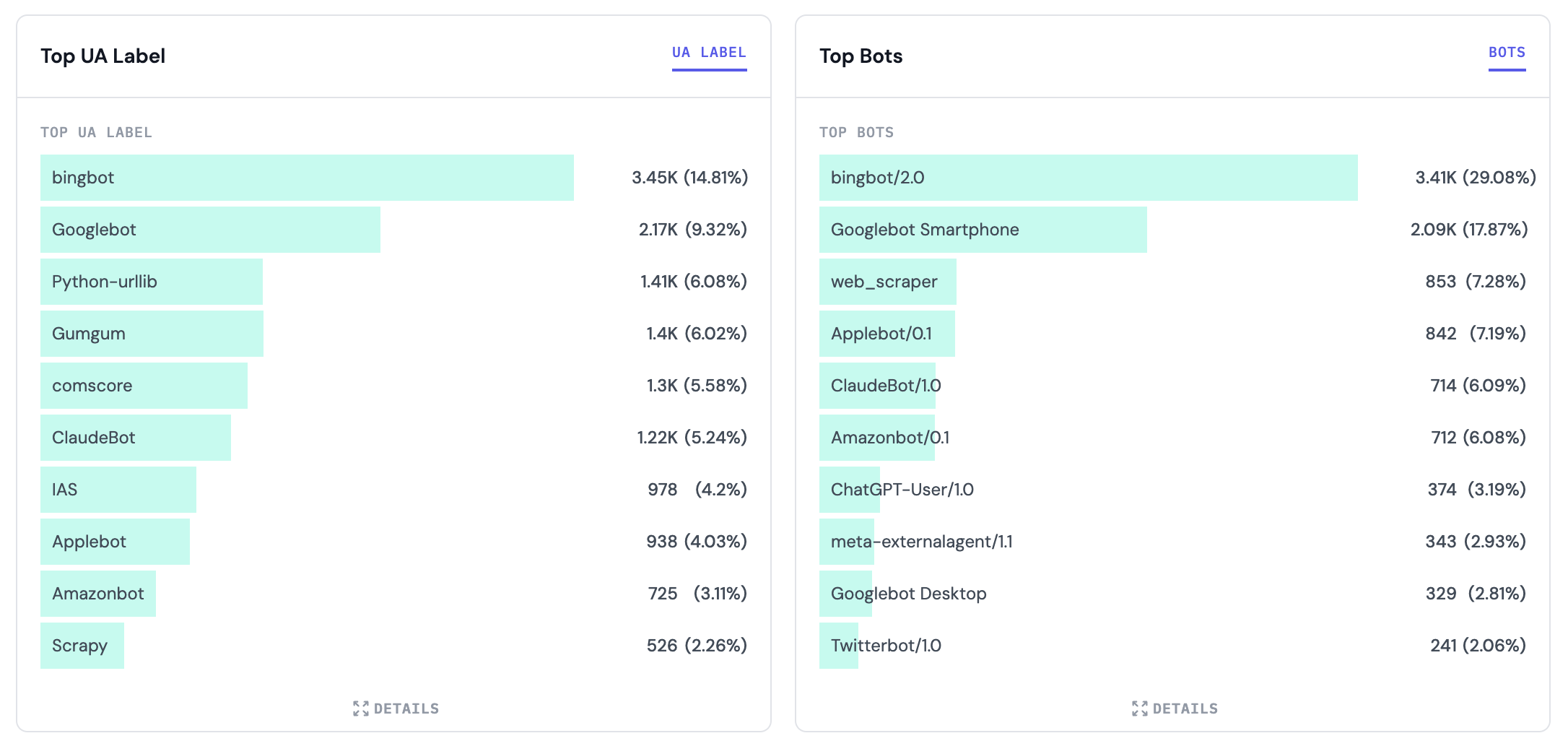 Top UA Labels and Top Bots — Transfon Security Dashboard
Transfon Security's server-side dashboard reveals the full landscape of bots hitting your site — from search engines to AI crawlers and scrapers.
Top UA Labels and Top Bots — Transfon Security Dashboard
Transfon Security's server-side dashboard reveals the full landscape of bots hitting your site — from search engines to AI crawlers and scrapers.
2. AI Crawlers Are Driving Up Server Costs and Harming User Experience
AI spiders don't just take your content — they consume your infrastructure while doing it.
Unlike search engine bots that follow robots.txt conventions and crawl at reasonable rates, many AI crawlers are aggressive. They send high volumes of requests, ignore crawl-delay directives, and hit resource-intensive pages repeatedly. The result is measurable damage to your operations:
- Increased server costs: More requests mean more compute, more bandwidth, and higher cloud bills. Sites running on auto-scaling infrastructure see costs spike from crawler traffic they never asked for.
- Higher server utilization: AI crawlers can push CPU and memory usage to levels that trigger performance degradation — or outright outages during peak periods.
- Degraded user experience: When bots consume server capacity, real users experience slower page loads, timeouts, and errors. For e-commerce sites, this directly translates to lost sales. For publishers, it means fewer pageviews and lower ad revenue.
A website that was comfortably handling its human traffic can suddenly struggle when multiple AI crawlers start hitting it simultaneously — and most site owners don't even realize it's happening until they see the hosting bill or get alerts about degraded performance.
3. AI-Powered Bots Are Burning Your Advertising Budget
The threat extends beyond content scraping and server costs. AI-powered automation systems are increasingly interacting with ads — clicking on paid search results, display ads, and social media campaigns.
These aren't the crude click bots of the past. Modern AI bots can mimic human browsing behavior — scrolling, hovering, clicking through pages — making them harder to distinguish from genuine users. When these bots click your Google Ads, Facebook campaigns, or programmatic display ads, you pay for every click while getting zero chance of conversion.
The impact on advertisers:
- Wasted ad spend on clicks that will never convert
- Distorted campaign analytics that make it impossible to optimize effectively
- Inflated cost-per-acquisition numbers that undermine your ROI calculations
- Budget exhaustion that prevents your ads from reaching real potential customers
The key to fighting this is visibility. You need to see exactly where your ad traffic is coming from — which IPs, which geographies, which sources — so you can identify anomalies and take action.
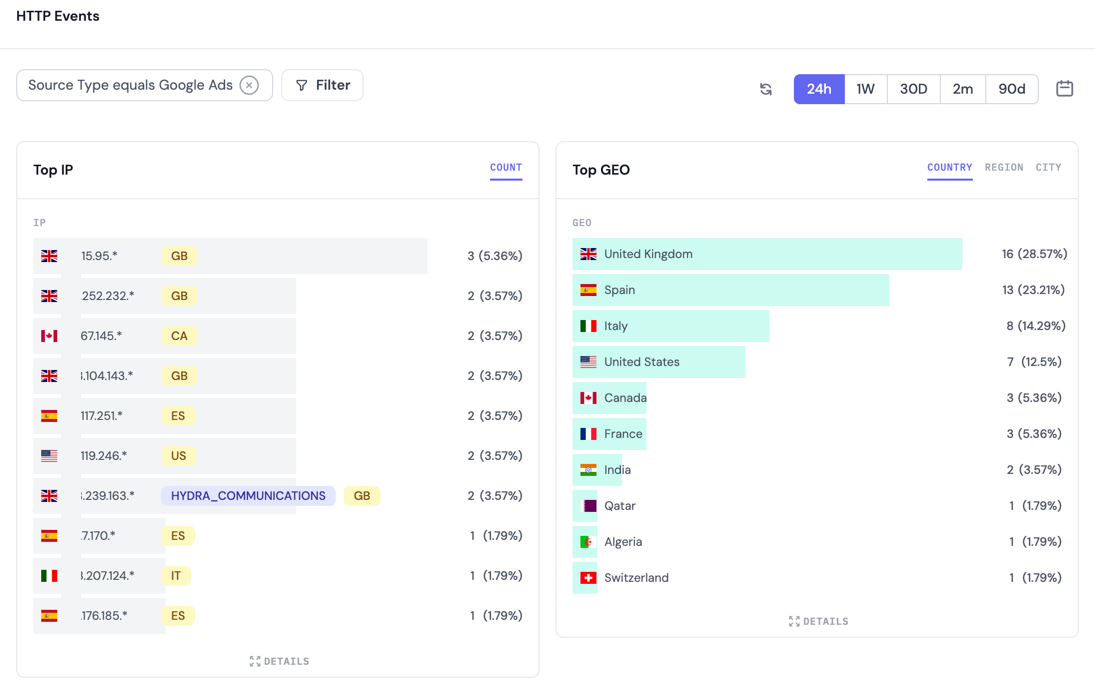 Ad Traffic Analysis — Transfon Security Dashboard
Transfon Security's client-side analytics let you filter by traffic source (e.g., Google Ads) and break down clicks by IP address and geography to spot suspicious patterns instantly.
Ad Traffic Analysis — Transfon Security Dashboard
Transfon Security's client-side analytics let you filter by traffic source (e.g., Google Ads) and break down clicks by IP address and geography to spot suspicious patterns instantly.
By analyzing your ad traffic at this level of detail, you can identify clusters of clicks from data centers, suspicious geographic concentrations, or IP ranges associated with known bot networks — and adjust your campaigns and blocking rules accordingly to optimize your investment budget.
4. AI Bot Traffic Dilutes Your Data Quality — Undermining Ad Optimization and BI
There's a less obvious but equally damaging consequence of AI bot traffic that many website owners overlook: data pollution.
Every modern advertising platform — Google Ads, Meta, programmatic DSPs — relies on high-quality behavioral data to optimize campaign delivery. Machine learning algorithms analyze user sessions, conversion paths, engagement signals, and audience segments to decide who sees your ads, when, and at what bid price. The better the data, the better the optimization.
When AI bots infiltrate your traffic, they inject noise into every layer of this data pipeline:
- Distorted audience signals: Bot sessions create fake behavioral patterns that confuse ad platform algorithms. Your "high-intent" audience segments may be contaminated with bot profiles, causing the platform to optimize toward more bot traffic instead of real customers.
- Inflated engagement metrics: Bots that scroll, click, and browse pages inflate metrics like time-on-site, pages-per-session, and event triggers. This makes low-quality traffic sources appear effective, leading you to allocate more budget toward channels that deliver bots, not buyers.
- Corrupted conversion data: Even if bots don't complete purchases, they can trigger micro-conversions — form views, add-to-cart events, page depth goals — that feed back into automated bidding strategies and skew your cost-per-acquisition calculations.
- Broken A/B testing and personalization: If a meaningful percentage of your traffic is non-human, your A/B test results are unreliable. You may roll out a "winning" variant that only performed better with bots, not with real users.
- Degraded retargeting pools: Bots that visit your site get added to retargeting audiences, meaning you'll spend money showing ads to non-existent users across the web.
- Unreliable BI and reporting: Dashboards and business intelligence reports built on polluted data lead to wrong conclusions. Revenue attribution, channel performance, and customer journey analysis all become untrustworthy when bot traffic is mixed in with real user data.
The problem compounds over time. Ad platforms learn from historical data — if that data has been polluted by bot traffic for weeks or months, the optimization algorithms are working from a fundamentally flawed baseline. Cleaning up bot traffic doesn't just save money on fraudulent clicks; it restores the data quality that every downstream system depends on to perform.
This is why filtering bot traffic at the source is critical. Transfon Security removes invalid traffic before it reaches your analytics and ad platforms, ensuring the data feeding your optimization engines is clean, accurate, and representative of real human behavior.
5. AI Bots Are Human-Driven and Hard to Filter
Here's the uncomfortable truth: AI bots are fundamentally different from traditional bots, and they're much harder to filter.
Traditional bots follow predictable patterns — they come from known data centers, use identifiable user agents, and behave in obviously non-human ways. You can block them with simple IP lists and user-agent rules.
AI bots are different. They are:
- Driven by human-like behavior patterns — AI systems are designed to mimic how real people browse, making behavioral analysis alone insufficient.
- Distributed across residential and cloud IPs — They don't always come from obvious data center IP ranges.
- Constantly evolving — As detection improves, AI bot operators adapt their crawling strategies.
- Sometimes legitimate — Some AI crawlers (like those from search engines building AI features) may be ones you want to allow.
This is why simple WAF rules and static IP blocklists aren't enough. You need flexible, adaptive controls.
Transfon Security's approach: Traffic Budget Control
Transfon Security addresses this with flexible decision rules including traffic budget control — a powerful mechanism that lets you:
- Set request volume limits per IP, per user agent, or per geographic region over configurable time windows
- Automatically throttle or block sources that exceed normal traffic patterns
- Detect abnormal request patterns such as unusually high page-per-session rates, suspiciously fast request intervals, or requests that skip typical human navigation patterns
- Create custom rules that combine multiple signals (IP reputation, geo, user agent, request rate, behavioral score) into precise filtering decisions
This means you don't need to know every bot in advance. If something is hitting your site with 10,000 requests per hour from a single IP range, Transfon Security can automatically detect and control it — whether it's a known AI crawler or an entirely new one.
6. Transfon Security: Full-Stack Bot Management for the AI Age
Protecting your website in the AI age requires more than a simple firewall or a blocklist. It requires a systematic approach that covers the entire lifecycle of bot management.
Transfon Security provides a full-stack solution built for this exact challenge:
Visualize
Before you can protect your site, you need to understand what's hitting it. Transfon Security's analytics dashboards give you complete visibility into your traffic:
- See every bot and crawler by user agent, IP, and geographic origin
- Break down traffic by source type — search engines, AI crawlers, scrapers, ad clicks
- Monitor traffic volumes and patterns in real time across configurable time windows
Identify
Transfon Security uses multiple detection layers to classify traffic accurately:
- User agent analysis to identify known bots and crawlers
- Behavioral fingerprinting to detect bots that disguise their identity
- IP reputation and network analysis to flag suspicious sources
- Request pattern analysis to spot automated behavior
Manage
Not all bots are bad. Transfon Security lets you make granular decisions:
- Whitelist good bots like Googlebot, Bingbot, and other search engines that drive organic traffic
- Monitor and rate-limit AI crawlers you want to allow but control
- Set traffic budgets for categories of traffic to prevent resource abuse
- Create custom decision rules that match your specific business needs
Block
When threats are identified, Transfon Security takes action automatically:
- Block malicious bots and scrapers in real time at the server edge
- Filter invalid ad traffic before it burns your advertising budget
- Prevent content scraping by AI systems that don't respect your terms
- Stop DDoS and volumetric attacks before they impact your infrastructure
This workflow of Visualize, Identify, Manage, Block gives you complete control over your bot traffic, letting you allow the bots that help your business while blocking the ones that harm it.
Take Control of Your Bot Traffic Today
The AI age isn't coming — it's already here. AI spiders are crawling your site right now, consuming your content, inflating your costs, and potentially burning your ad budget. The question isn't whether you need bot management, but how quickly you can deploy it.
Transfon Security gives you the tools to see, understand, and control every bot that touches your website — from a simple JavaScript tag for ad traffic analysis to a full server-side WAF for comprehensive protection.
Get started in minutes:
- Start your free 14-day trial — Deploy Transfon Security and see your bot traffic within minutes. No credit card required.
- Contact our team — Have questions about your specific use case? Our security experts can help you design the right protection strategy.
Don't let AI bots drain your content, your servers, and your budget. Take control with Transfon Security.
Transformation Strategies for Publishers and Marketers
Data Privacy and Security, Performance and User Experience, Regulation Compliance, User and Revenue Growth
Stay ahead of the publishing curve
Privacy, security, monetization, and performance insights. A few emails a month, no spam.